

Report

Competitiveness in the EU Single Banking Market
As a follow-up to the Draghi agenda, the European Commission is expected to publish a report on competitiveness in the Single Banking Market in 2026.[1] The European Commission has promised to assess the overall situation of the banking system, including evaluating banking sector competitiveness. It has noted the need to avoid a global regulatory race to the bottom in banking regulation, to reduce barriers to market integration and undue administrative burdens, and to avoid penalising EU banks that compete on international markets.
The core aim of the Draghi report is to raise productivity growth for the whole EU economy, as a pre-condition for increasing the Union’s strategic autonomy. As banks are the major source of private financing in the EU, the hope is that by reviewing EU bank regulation, simpler rules and improved market access will help banks to increase their lending to support this goal.
This presents a carefully balanced mandate for the simplification of bank regulation. The European Commission must find ways to improve the single banking market while at the same time evaluating (not promoting or facilitating) the competitiveness of the banking sector. Success should be defined as the EU having a strong and resilient banking sector: as the EU’s funding needs increase, the financing capacity of banks will need to increase, which requires them to have a strong capital base. As external and internal threats to financial stability multiply,[2] the resilience of EU banks must also stay strong, because the EU can ill afford a major banking crisis now, politically or economically.
Stronger and simpler financial regulation can thus build market stability and certainty, which the EU needs to raise its productivity growth and strategic autonomy.
However, it cannot be ignored that some financial sector lobbyists have conflated Draghi’s goal of strengthening the EU’s competitiveness with strengthening the banking sector’s own competitiveness, which, they suggest, can be achieved by weakening the EU’s rules on bank capital.[3] They may have been encouraged by the Draghi report’s observation that bank profitability can support lending,[4] forgetting that (a) EU banks have enjoyed an extraordinary run of profits, dividends and share buybacks in recent years and (b) bank profits only increase lending to the extent that they are retained as capital to fund more bank lending. In fact, there is no problem with EU banks’ profits.
Policymakers are used to special interest lobbying and can weigh such interventions on their merits. As the European Central Bank’s (ECB) supervisory board chair, Claudia Buch, said, “the perspective of banks and their shareholders may not fully reflect the perspective of society more broadly”.[5]
Numerous regulators and supervisors have also spoken recently to confirm that competitiveness and simplification should not mean deregulation, for example:
The task facing the European Commission is, in simple terms, to simplify bank regulation without weakening it. This position paper addresses some of the false narratives around simplification and competitiveness in the banking market and introduces Finance Watch’s recommendations for this agenda.
The ability of European banks to maintain profitability and attract investors has not been affected by regulation, contrary to what some may claim.[9] As this section shows, European banks are booming and could have grown even faster, had they not chosen to increase their profit payout ratios.
European bank profits have soared in recent years: the combined annual net profits of significant institutions in the Single Supervisory Mechanism (SSM) more than doubled to EUR 187bn between December 2019 and December 2025.[10] With non-performing loans (NPL) down, thanks to previous regulatory intervention, and interest rates up, there is no evidence that banks are having difficulty in maintaining profitability.
Over this time, SSM banks increased their ratio of profits paid out in dividends and share buybacks from 44%[11] of profits before the pandemic to 53%[12] of (a larger amount of) profits in the years after. The ECB’s Financial Stability Review November 2025 noted that the share prices of euro area banks have been “driven by sustained strong earnings momentum and record profit distributions (dividends and buybacks) in recent months, with price-to-book ratios rising to new post-financial crisis highs and gradually catching up with those of US peers”.[13] This was reflected in strong investor sentiment, with the EURO STOXX index of share prices for European banks nearly quadrupling since 2019. There is no difficulty in attracting investors.
It is true that there has been a historical difference in return on equity rates between EU Global Systemically Important Banks (G-SIBs) and their US peers. However, this has been largely explained by other factors. An ECB analysis puts the difference down to larger US banks having more trading and fee income in a more market-based financial system, more investment in technology and expertise that enabled US banks to dominate the lucrative investment banking business globally, more domestic market concentration and pricing power, and access to a larger single domestic market than peers in the EU (with its 27 countries and 24 official languages).[14] These structural differences are beyond the reach of most prudential regulation, although the completion of the Banking Union may increase market share for some EU players. EU bank profits had also been weighed down by NPLs, which are less of an issue now: the NPL ratio including central bank balances among eurozone significant institutions has fallen from a high of 7.5% in 2015 to 1.9% in Q4 2025.[15]
The banking industry’s claim that regulation has affected its ability to finance the economy can also be challenged by the data. As mentioned, European banks in the SSM system have increased their profit distributions in recent years. With the remaining profits, they were able to add a cumulative EUR 300bn[16] in common equity tier 1 capital (CET1) over the six years from December 2019 to December 2025, raising average CET1 ratios from 12% to 15% and increasing loans and advances by 18%.[17] That is good news, but if banks had chosen to distribute fewer profits, they could have added three times as much CET1 and increased their lending capacity accordingly, assuming sufficient demand for credit. If banks really do have limited ability to finance the economy, it mainly reflects their own preferences. In summary, EU banks are profitable, investable and could already increase their real economy financing if they choose.
A commonly seen claim is that the EU should level down its prudential regulation to help European banks compete with international rivals, especially in the US. This section shows why this claim is ill founded: G-SIB rules are actually weaker in the EU than the US and could be levelled up, while O-SIIs (Other Systemically Important Institutions) are better protected in the EU than US peers and should stay that way.
European G-SIBs operate under a less stringent regulatory framework than their US peers. That is true now and, as shown below, seems set to remain so after planned changes to US banking regulation, for both risk-based and leverage requirements.[18] For G-SIBs, there is nothing to level down to; if anything the EU should be levelling up.
At first glance, current US risk-based requirements appear to be more relaxed than in the EU because of lower headline ratios. But these ratios are applied to risk-based assets, which are higher in the US than the EU because of the so-called Collins Floor.[19] Before these standards can be compared internationally, it is necessary to adjust for this discrepancy; as the Bank of England said in December, “an unadjusted comparison is misleading, especially relative to the US”.[20] Unfortunately, this did not stop the banking lobby from publishing unadjusted comparisons and giving the misleading impression that European capital standards for G-SIBs were higher than in the US.[21]
When the ECB adjusted for the Collins Floor in 2023,[22] it found that “the average requirement for European banking union significant institutions as a whole would be somewhat higher under the US rules”. The Bank of England’s adjusted comparison from December 2025 also found that “US banks’ risk weights continue to be higher than those of UK [and EU] banks”.[23] To put a number on this, the Bank of England’s report shows in its Chart 5 (reproduced below) that adjusted risk-based requirements for G-SIBs are around 8-9% higher in the US (i.e. 9.8% CET1 requirements versus 9.0% in the EU).
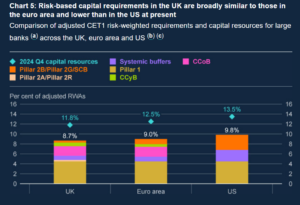
Source: Bank of England, December 2025, Financial Stability in Focus[24]
This is the current situation. In March 2026, the US Federal Reserve proposed a series of reforms to US capital regulations.[25] The proposals are complex and fall outside the scope of this paper. However, the accompanying Memo to the Board of Governors of the Federal Reserve System summarises that “the cumulative impact of all proposals on risk-based capital requirements – including proposed stress testing changes – would lower the common equity tier 1 capital requirements of Category I and II firms by 4.8%” (relative to current levels).[26] As this is smaller than the existing 8-9% difference in CET1 requirements between the US and EU calculated by the Bank of England, this suggests that the US will continue to have slightly more stringent capital rules for G-SIBs than the EU, even if the proposed US rules are implemented in full (please note, the percentages represent the relative changes in capital required, not changes to the ratios themselves).
The picture is similar with leverage requirements. US G-SIBs will on average be subject to a 3.7% leverage requirement, after a planned reduction in the US’s enhanced supplementary leverage ratio has been implemented, versus 3.3% in the EU, excluding P2G, according to the same Bank of England report.
The conclusion for G-SIBs is that EU standards are on the low side as compared to the US and could, if anything, be levelled up.
O-SIIs in the EU are subject to the same 3% leverage requirement as their US equivalents (Category II and III banks, under the US Tailoring Rule[27]), according to the Bank of England. For risk-based capital, O-SIIs in the EU are subject to an average CET1 requirement of 8.9% versus 8.3% for their US peers. The difference is because the EU applies systemic buffers to O-SIIs as well as G-SIBs, while the US opted to apply systemic buffers only to G-SIBs. As the failure of Silicon Valley Bank (a Category IV bank when it failed) showed, even a small bank failure can cause widespread losses and systemic threats. The US banking system has been left dangerously exposed by this gap. Finance Watch concludes that the EU should keep its O-SII buffers and keep them strong.
Regardless of the discussion above, policymakers should, on principle, not be using capital requirements to give EU banks a competitive advantage over international rivals. Supervisors must be free to rely on Basel minimums to avoid a regulatory race to the bottom and to set higher local standards where necessary to reflect prudential threats and market characteristics in their jurisdiction.
As there are conflicting (and sometimes incorrect) narratives promoted around bank capital, this section revisits how capital provides resilience and enables credit growth. It explains why credit growth from a strong capital base is financially sustainable and protects the system, unlike credit growth from reduced capital requirements, which is one-off and harms resilience. It also suggests a mechanism to ensure that any changes to capital requirements actually deliver the benefits used to justify them.
Estimates suggest that a full-blown banking crisis could cost an enormous 43% to 63% of GDP, on a net present value basis.[28] A large part of this comes from the loss of credit supply when banks are under-capitalised going into a crisis and extend “much less credit for several years after a crisis”, leading to economically sizable social costs.[29] Capital also helps banks to fail safely in normal times, which is important for their social licence and for citizens to maintain trust in a market economy.
Banks with more capital have more lending capacity, which directly benefits the economy when used to finance productive activities. The Draghi report identified an annual funding gap of EUR 800bn to meet the EU’s decarbonisation, digitalisation, defence and productivity needs, to which it hopes banks can contribute.[30] As the European Savings and Retail Banking Group manifesto put it, “well capitalized responsible banks are the best guarantee for SMEs to flourish.”[31] The same is true for larger borrowers.
The credit growth mechanism works as follows: As demand for loans increases, banks fund their credit expansion by taking on more debt themselves, which is easier and cheaper to do when banks have more equity. Conversely, it may be difficult or impossible for banks to increase credit if they have too little capital. As the new lending generates profits, banks can retain a portion of profits to rebuild capital ratios, and the cycle can begin again. Equity is the starting point and the enabler for sustained and resilient credit expansion.
When Bank for International Settlements (BIS) head of research, Hyun-Song Shin, analysed the data behind this mechanism, he concluded: “the elasticity of total lending with respect to book equity is very close to one… If the objective of central bankers is to encourage greater lending, then equity is key, not more debt.”[32] On this basis, any reductions to the capital strength of banks are likely to weaken the long-term funding capacity of the EU’s banking system, which is surely not an outcome that policymakers wish for.
While capital is the basis for lending and its growth, it is also true that cutting capital requirements can provide a one-off increase in lending, depending on how banks deploy the freed-up capital. This short-lived mechanism is what financial industry representatives promote to policymakers in support of deregulation. However, credit growth achieved this way reduces future capacity for lending growth, which is essential for the banking sector to contribute to closing the EU’s funding gap. With banks paying out more than half of their profits in dividends and share buybacks, there would be a strong incentive for banks to simply pay out any capital released if requirements were lowered. That would be a lose-lose outcome for the Draghi agenda: less resilience and no gain in financing capacity.
If some of the capital were retained to support an increase in bank assets, there is still no guarantee of how much it would close the funding gap. ECB data for loans by monetary financial institutions (i.e. banks) to the private sector show that, between 2019 and 2025, EU banks increased their lending to financial firms such as hedge funds, private credit, private equity, and real estate funds 2.5x faster than they increased their lending to real economy businesses. The result was that loans to non-financial companies – the sector where most productivity growth happens – fell to only 14.6% of total bank assets by the end of this period, continuing a worrying long-term downward trend.
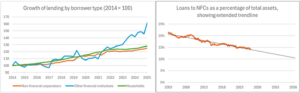
Source: ECB data for euro area MFIs (Loans to the private sector[33], Balance sheets of MFIs[34])
Industry-sponsored studies tend to assume that all changes to capital requirements feed straight through to higher real economy lending, often at multiples between 10x and 20x, leading to wild claims about trillions in additional lending. As explained above, there are good reasons to treat such estimates with caution. In addition, any increase in lending that does result from deregulation is likely to reflect an underpricing of risk, storing up problems for the future. The better route to increase bank lending in the EU is to nurture a banking sector with the capital strength to grow sustainably and organically from its own profits, not from one-off capital reliefs.
If capital requirements were to be weakened, a move that Finance Watch advises against, it would be essential for supervisors to ensure that (a) banks do not pay out the “freed-up” capital in profits and (b) that “freed-up” capital is deployed in support of real economy lending. That would at least help to ensure that the loss of resilience and capacity for banks to grow their future lending could be offset, at least in part, by a one-off gain in productive financing.
Past deregulations have not had such mechanisms, even when they have been justified as improving real economy financing.[35] However, the precedent exists. Careful supervision during the implementation of Basel III ensured that EU banks built capital to meet new requirements by retaining profits and not deleveraging, thus maintaining credit supply.[36] It should be possible to develop a formal supervisory mechanism to oversee all changes to capital requirements, whether upwards or downwards, to capture the public benefits and ensure that regulatory changes deliver the outcomes used to justify them.
This section summarises Finance Watch’s proposals to simplify prudential rules and improve the operational environment, so that banks can more easily serve the economy. Other improvements could include reducing market fragmentation, completing the Banking Union and Capital Markets Union, harmonising supervision, and removing national divergences in the implementation of EU law (the move from Directives to Regulations).
1. Balance the role of leverage and risk-based requirements in the capital framework
Finance Watch recommends raising the leverage ratio requirement so that leverage and risk based requirements play more balanced roles in the capital framework, instead of preserving the current prioritisation of risk based requirements as the binding constraint. Unlike risk-weighted metrics, leverage ratios are harder to manipulate and provide a clearer view of bank solvency. Lifting leverage requirements above current levels would reduce systemic risk, improve resilience during downturns, reduce adverse incentives in capital management, and enhance banks’ return on assets.
2. Simplify the capital stack without weakening it
The current EU capital framework is highly complex, with multiple overlapping requirements (“capital stacks”). Finance Watch recommends a package of measures to simplify the framework, involving:[37]
The result would be a more transparent, efficient system with fewer compliance costs, improved usability of buffers, and better alignment between regulation and market perceptions. Overall, the number of capital stacks in use could be halved, without weakening resilience.
3. Phase out the regulatory use of internal risk models
Regulators in the US are already proposing to phase out the use of internal models for credit risk and operational risk.[38] Finance Watch recommends that the EU also phase out the regulatory use of the Internal Ratings-Based (IRB) approach. It is complex, costly, and not always reliable. It creates incentives for banks to minimise capital rather than manage risk, distorts competition in favour of large banks, and reduces transparency for investors and supervisors. Removing IRB from regulatory capital calculations would improve comparability across banks, massively reduce the complexity of regulation, and strengthen financial stability. Internal models could still be used for internal risk management. Finance Watch recommends replacing IRB with the simpler Standardised Approach.
4. Support small banks
Finance Watch supports the concept of a simplified regulatory regime for small and non-complex banks based on simple but robust leverage and liquidity thresholds, with a stepped implementation to avoid cliff-effects. This would support local lending, especially to SMEs and under-served sectors.
To be internationally competitive, the EU must consider not only how to simplify bank regulation but also how to maintain bank resilience. Strong regulation and supervision leads to resilient banks, sustainable lending growth, and a strong and resilient economy. Policymakers should also set KPIs for the banking sector to link the outcomes of bank financing to the real economy.
Footnotes
Footnotes
[1] As announced in the earlier Communication on the Savings and Investment Union COM(2025) 124 final.
[2] European Banking Authority. Risk Assessment Report (RAR), December 2025.
[2] European Banking Authority. Risk Assessment Report (RAR), December 2025.
[3] For example, of the 16 recommendations on bank capital stacks published by one bank lobby group (AFME), nearly half (7) are not simplifications and nearly all (15) would lead to a weakening of the prudential framework.
[4] Draghi, M., The future of European competitiveness, Part B, In-depth analysis and recommendations, p. 287. 2024.
[5] Buch, C. Bank profitability: a mirror of the past, creating a vision for the future. Bocconi University, 16 October 2024.
[6] European Central Bank. High-Level Task Force on Simplification.
[7] Donnery, S. Less regulation, more growth? It’s not that simple. SSM Senior Forum, 25 June 2025.
[8] Schnabel, I. Resisting deregulation: safeguarding bank resilience in an evolving financial landscape, Farewell symposium in honour of Klaas Knot, 3 October 2025.
[9] For example, the EBF sent letters to the Presidents of the European Commission and European Council in January and February 2026 claiming – incorrectly in light of the evidence we present here – that “European banks operate under a more stringent and extensive regulatory framework than their global peers, affecting their ability to finance the economy, maintain profitability, and attract investors”.
[10] European Central Bank. Profit and loss figures. 18 March 2026.
[11] Couaillier, C., Dimou, M., Parle, C. Banks’ capital distributions and implications for monetary policy, 2023.
[12] Buch, C. Bank profitability: a mirror of the past, creating a vision for the future. Bocconi University, 16 October 2024.
[13] European Central Bank. Financial Stability Review, November 2025.
[14] Di Vito, L. et al. Understanding the profitability gap between euro area and US global systemically important banks, European Central Bank Occasional Paper Series.
[15] European Central Bank. Supervisory Banking Statistics, Non-performing loans and advances.
[16] European Central Bank. Supervisory Banking Statistics, Total capital ratio and its components.
[17] European Central Bank, Supervisory Banking Statistics, Composition of assets.
[18] Board of Governors of the Federal Reserve System. Agencies request comment on proposals to modernize the regulatory capital framework and maintain the strength of the banking system, 19 March 2026.
[19] The Collins Amendment to the Dodd-Frank Act requires banks to assess capital using both standardised and internal models, applying the higher of the two (‘the Collins floor’). The Bank of England explains that the EU captures some risks that are missing or underestimated in P1 through P2R, which raises the ratio requirement, while the US tends to capture more of those risks directly in P1 RWAs, largely through the Collins floor.
[20] Bank of England. Financial Stability in Focus: The FPC’s assessment of bank capital requirements, 2 December 2025.
[21] AFME, Simplifying the EU Capital Stack, March 2026.
[22] Enria, A, ECB Supervisory Board Chair. Banking supervision beyond capital. EUROFI 2023 Financial Forum, September 2023.
[23] Bank of England. Financial Stability in Focus: The FPC’s assessment of bank capital requirements, 2 December 2025.
[24] Ibid.
[25] Board of Governors of the Federal Reserve System. Agencies request comment on proposals to modernize the regulatory capital framework and maintain the strength of the banking system, 19 March 2026.
[26] Board of Governors of the Federal Reserve System. Basel III proposal, GSIB surcharge proposal, and standardized approach proposal, 19 March 2026.
[27] Board of Governors of the Federal Reserve System. Tailoring rule visual, 2019.
[28] Brooke, M. et al. Measuring the macroeconomic costs and benefits of higher UK bank capital requirements, December 2015; Basel Committee on Banking Supervision. An assessment of the long-term economic impact of stronger capital and liquidity requirements, August 2010.
[29] Budnik, K. et al. The benefits and costs of adjusting bank capitalisation: evidence from euro area countries, April 2019; Jiménez, G. et al. Credit Supply and Monetary Policy: Identifying the Bank Balance-Sheet Channel with Loan Applications, 2012; Jordà, O. et al. Bank Capital Redux, 2017.
[30] Draghi, M., The future of European competitiveness, Part A, A competitiveness strategy for Europe, September 2024.
[31] European Savings and Retail Banking Group. Proposals for Responsible Retail Banking 2024-2029.
[32] Shin, H. On book equity: why it matters for monetary policy. Keynote address, Joint workshop by the Basel Committee on Banking Supervision, January 2015.
[33] European Central Bank. Sectoral breakdown of MFI loans (excluding the Eurosystem) to the private sector.
[34] European Central Bank. Consolidated balance sheet of euro area MFIs.
[35] For example, the EC’s 2025 proposal on prudential relief for securitisations was meant to help SMEs benefit from the increased lending capacity of banks but there is no oversight or mechanism to ensure that this actually happens. Similarly, when the Bank of England lowered its benchmark for Tier 1 capital for UK banks by 1% in the December 2025 Financial Stability in Focus, it said it “would expect banks to use any such changes as a means to increase their support of households and businesses in the real economy” but provided no mechanism to ensure this happens.
[36] For the text of EBA and ECB supervisory recommendations, see EBA/REC/2011/1 and ECB/2015/49. For the final impact on lending, see Basel III Monitoring Report 2019 and BCBS Evaluation of the impact and efficacy of Basel III reforms, 2022, also summarised in this Finance Watch blog.
[37] Details will be published separately.
[38] The Federal Reserve proposed in March 2026 to replace the dual stack approach for Category I and II banks with a new “expanded risk-based approach” that would remove internal models for credit and operational risk and follow similar mechanics to those in the current standardized approach to determine risk-weighted assets for credit risk. See Notice of proposed rulemaking: Regulatory Capital Rule: Cat I and II Banking Organizations.
Share

Retail & Inclusion
Level:Beginner
06.05.2026

Miscellaneous
Level:Regular
29.04.2026

Sustainable Finance
Level:Expert
24.03.2026
You can help tip the balance! Strengthen our impact by joining our collective efforts.